
Blog / 23 Apr 2025
Sometimes I Doubt Your Commitment to Framer Motion
A developer’s deep dive into Framer Motion, layout animations, and why trusting height: 'auto' might just change the way you build UI forever. Inspired by Donnie Darko, frustration, and the thrill of things that just work.
TL;DR: height: 'auto' is a thing in Framer Motion, and it changed everything.
Twenty-eight days, six hours, forty-two minutes, twelve seconds.
That’s how long it felt like I spent trying to measure the height of a div manually before realizing Framer Motion just… handles it.
And by “handle it,” I mean it gave me an animation that worked the first time. No useRef, no scrollHeight, no setTimeout, no confusion at all — unlike that time I woke up on a putting green with no idea how I got there.
Just smooth, expanding UI bliss with height: 'auto'.
Wait… who woke up on a putting green?
I Was Just Trying to Unfurl Some Divs
I love the look of a section that expands smoothly — like when you click a category and the content unfurls beneath it. (Is that the right word? Maybe not. But it fits my vibe.)
In my case, I was mapping out categories, each opening up a group of feature rows. Each row had content that could grow, including a video player that revealed itself with a button click.
So I used useRef to measure the height on open. It mostly worked… until it didn’t. Nested videos broke everything. The ref wouldn’t pick up the change fast enough. scrollHeight came back stale. I threw in setTimeout.
I was trying to force the DOM to bend to my will.
And that’s when Donnie's voice popped into my head:
There are other things that need to be taken into account here, like the whole spectrum of framer motion.
Wait… Framer Motion?
The ScrollHeight Spiral
So the idea is: when new content renders, use the ref to measure scrollHeight, then animate your container to that height. It works in many cases.
It works… until it doesn’t.
And that’s when the doubt sets in. And suddenly you’re staring at your console log like Grandma Death at her mailbox, waiting for a message that means something this time — not just in your code, but in your commitment to layout animation as a concept.
I was questioning my commitment to Framer Motion.
The Sparkle Motion Moment
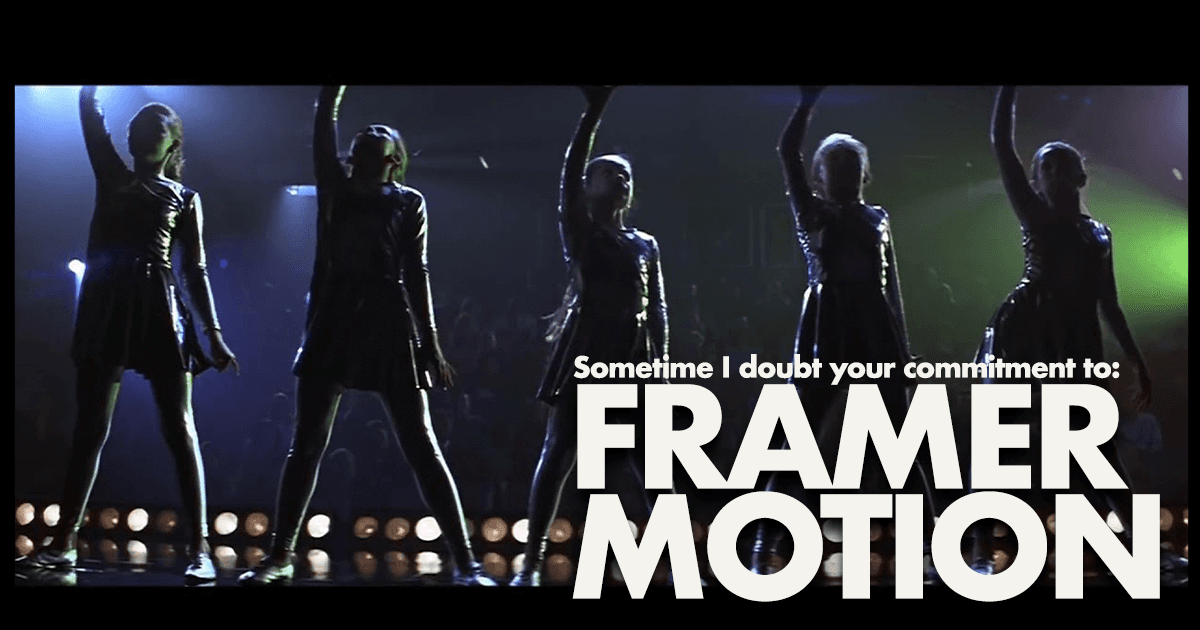
There’s a scene in Donnie Darko where Kitty Farmer shouts:
“Sometimes I doubt your commitment to Sparkle Motion!”
That line echoed in my head as I was struggling with this issue… and then, like through a wormhole, it was presented to me: height: 'auto'.
Surely that can’t work. Browsers don’t animate to auto, right?
But I tried it anyway.
initial={{ height: 0, opacity: 0 }}
animate={{ height: 'auto', opacity: 1 }}
exit={{ height: 0, opacity: 0 }}
transition={{ duration: 0.3 }}
style={{ overflow: 'hidden' }}
And it just… worked.
The important addition is overflow: 'hidden' — it keeps everything tucked neatly inside the surrounding div.
No useRef, no measuring, no delay tricks. Framer Motion did the layout calculation behind the scenes and gave me the smooth unfurl I’d been searching for.
What’s Actually Happening
Framer Motion uses a layout measurement system internally — so when you use height: 'auto' in a motion.div, it measures before and after render and animates the change.
It’s like scrollHeight, but with none of the stress.
It also plays beautifully with AnimatePresence, so your exits are as clean as your entrances.
This excludes Frank’s.
So Should You Ditch useRef Forever?
Definitely not. I still find useRef incredibly useful — especially when working with video elements. I’ve used it to access the duration of a video. It’s great for tapping into properties you can’t reach through state or props alone.
But when it comes to animating height based on content — especially when that content changes dynamically — I’ve stopped reaching for refs.
If height: 'auto' gets me there without the hassle?
I’m in.
Sometimes, you just gotta trust the Motion.
After all, it’s not the size of the ref… it’s the Framer of the Motion… or something like that.
Final Thoughts
They say fear and love are the deepest of human emotions. But did that person ever get caught up in a front-end development bug? Because that got me in some deep emotions.
“What if you could go back in time, and take all those hours of pain and darkness and replace them with something better?” Gretchen said in the movie.
I wish I could, Gretchen. Yes I do…
But maybe those rough learning patches — the ones where you wake up confused on a metaphorical putting green, unsure how you even got there — are what shape us the most. Not just as developers, but as thinkers, builders, and people willing to wrestle with complexity until something clicks.
And I no longer doubt my commitment to Framer Motion… most of the time.
Sometimes it still seems a bit janky.
Honestly, does it get much better than this scene? If you’ve never seen Donnie Darko, it’s for sure worth a watch… I personally don’t love how the ending unravels, but it does a lot right.